
Exhibition Review: Chuck Close – Prints, Process and Collaboration
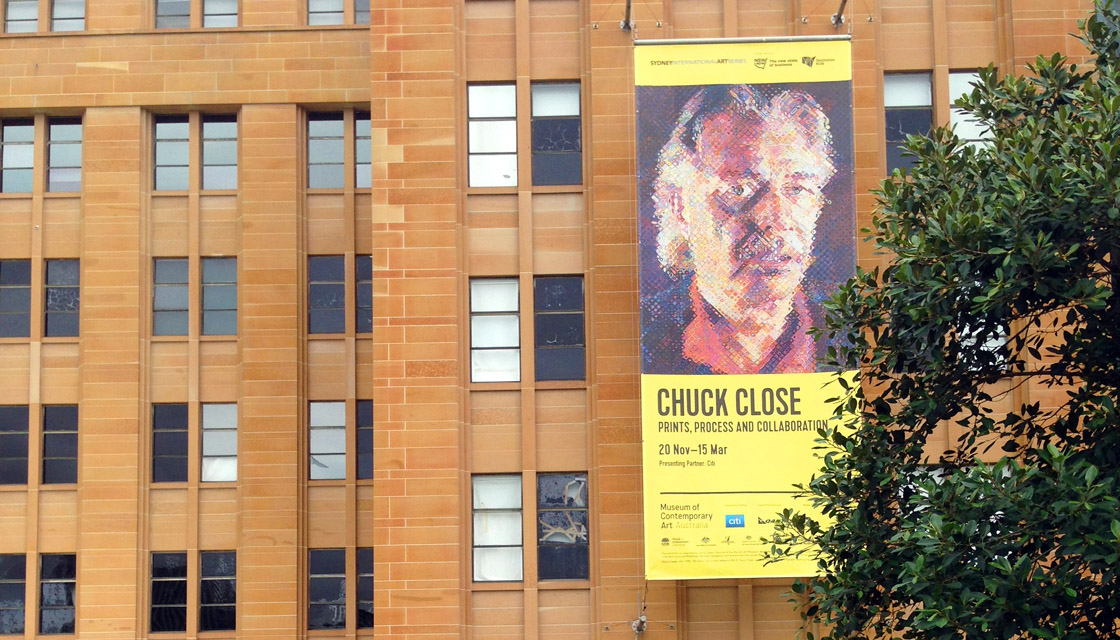
The exhibition of American artist Chuck Close – Prints, Process and Collaboration is in its final days at the Museum of Contemporary Art (MCA) in Sydney. The exhibition is curated by MCA consulting curator Glenn Barkley with American curator Terrie Sultan of New York’s Parrish Art Museum. It is the first large collection of Close’s work to be shown in Australia, and well worth visiting before it ends.
The accompanying exhibition material includes videos taken at Close’s studio discussing his art practice. The videos also reveal an amazing human story of determination. Close has a rare condition called prosopagnosia or ‘face blindness’ which kept him from recognizing other people. Later in life he became paralyzed due to a collapsed spinal artery. Determined to continue working, he went on to design his studio so that he could continue to make art despite his disabilities.
During the 1960s, Close was already a well-established artist and worked alongside specialists particularly in the field of print making. He has continued this collaborative process, and has adopted a wide variety of techniques including etching, aquatint, lithography, handmade paper, silkscreen, traditional Japanese woodcut, and reduction linocut. Despite the incredible breadth of his techniques and varied collaborative partners, each work is clearly of his oeuvre, a testament to the discipline and self-imposed limitations applied to each work.
Close intentionally selected portraiture as his focus in the 1960’s when it was commonly considered irrelevant to the art world due to the progression of technological devices such as cameras. His portraits, or ‘heads’ as he calls them, gaze directly at the viewer, often controlled or disinterested. Close then uses photographs of his subjects, frequently artists and celebrities to create the portraits. The work is laid out on a grid; each square contains a piece of the puzzle that then makes up the whole. These abstracted units of the grid strip away the subjective gaze, asking the viewer to reassemble it for themselves. This process of reassembly is interactive, the reference grid, abstract pattern and colours allow us to reinterpret the information afresh.
Close employs a variety of tools and materials to make his work. Fingerprints translated to direct gravure, handstamps, paper pushed through mesh onto board, yarn woven into textile works, and his imaginative use of techniques seems boundless. This variety of techniques creates a vibrancy to the work, despite the restricted subject matter, his ‘heads’ are anything but boring.
A common thread in Close’s work is the precisely controlled application of colour, often a result of the mechanical printing processes used. Close has a deep understanding of how to build up and control colour in print. A work that appears to be just a few shades of grey, may actually be built from hundreds of colours. The print processes are also on display in the exhibition, revealing how Close is able to both deconstruct and build up each work. His impressive ‘heads’ often emerge in reverse, working highlights from a dark ground. In the complex process of his work Keith/Mezzotint (1972), the figure at is both revealed and covered using the black of the mezzotint.
In an interview with Terrie Sultan, Close describes himself as wanting to have been a magician, but ruined his chances by revealing how the trick was done. Prints, Process, and Collaboration shares Close’s ‘box of tricks’, however the expertise with which he handles each medium reveals a masterful level of control not easily replicated. This exhibition showcased Close’s mastery of illusion, and provided a reminder that creativity benefits from the use of all the tools at ones disposal, Close asks each one of them to do more than we believed possible.
The exhibition runs until the 15th March, for more information go to http://www.mca.com.au/exhibition/chuck-close-prints-process-and-collaboration/
Reviewed by Kerry after her visit to the MCA.
Reference:
Exhibition, Chuck Close – Prints, Process and Collaboration 2015, Museum of Contemporary Art Limited, http://www.mca.com.au/exhibition/chuck-close-prints-process-and-collaboration/
Koloff, S 2014, Chuck Close, face-blind portrait painter, Australian Broadcasting Corporation.
McDonald, J 2015, ‘Chuck Close prints at Museum of Contemporary Art require so much more than a glance’, Sydney Morning Herald, http://www.smh.com.au/entertainment/spectrum-now-2015/chuck-close-prints-at-museum-of-contemporary-art-require-so-much-more-than-a-glance-20141118-11oev3.html
Alinta Krauth At White Night Melbourne
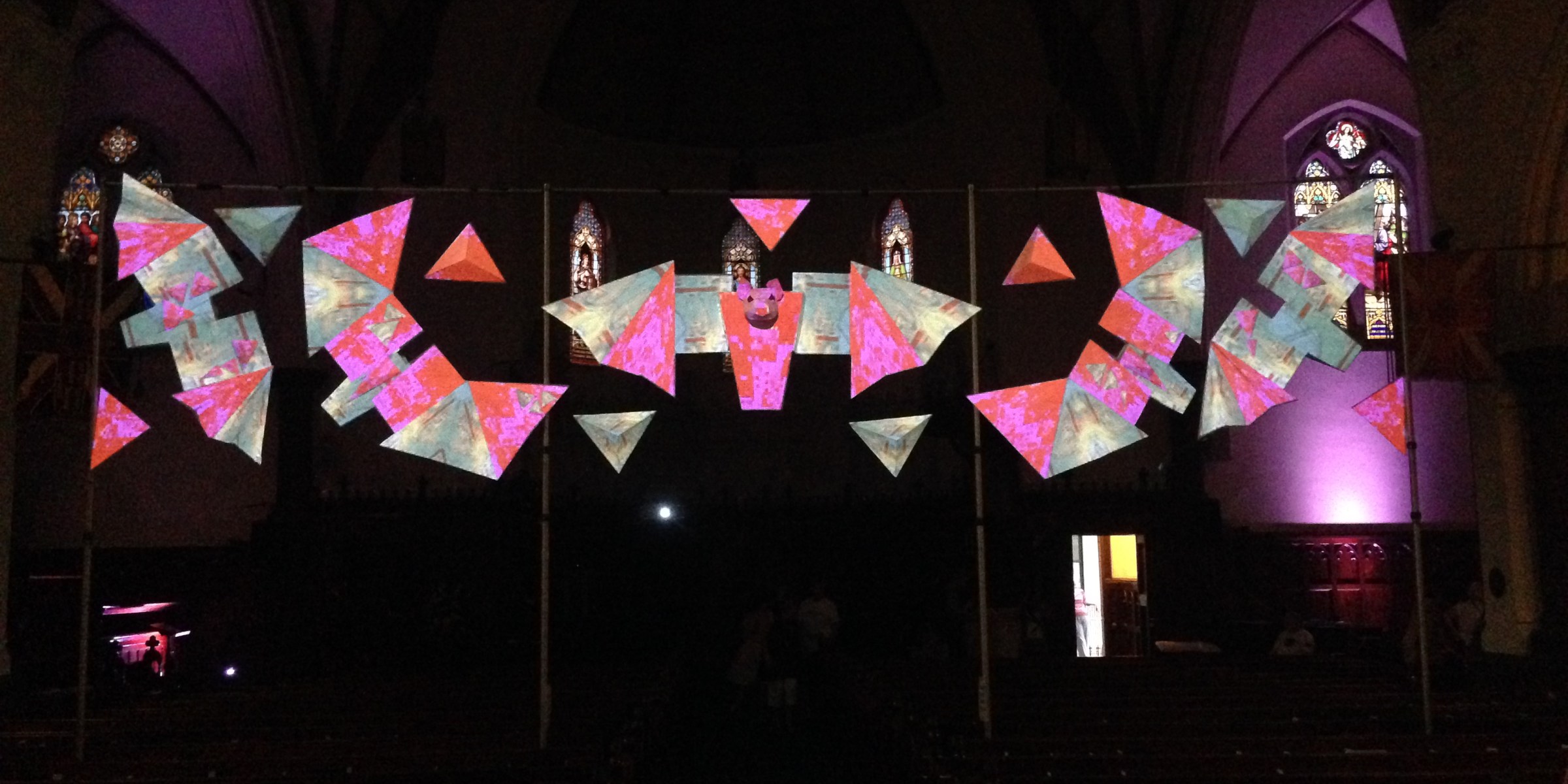
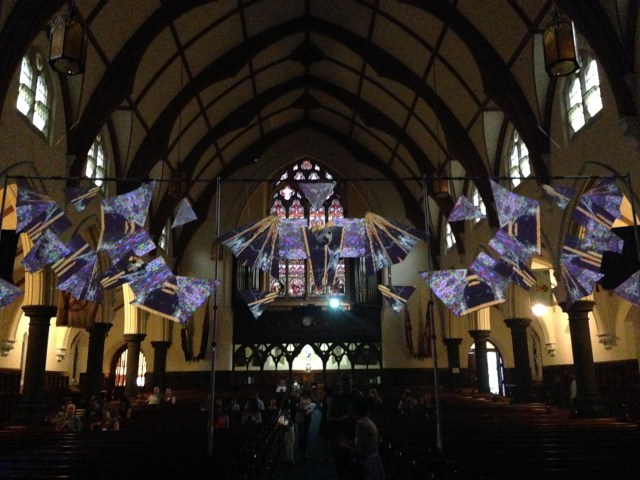
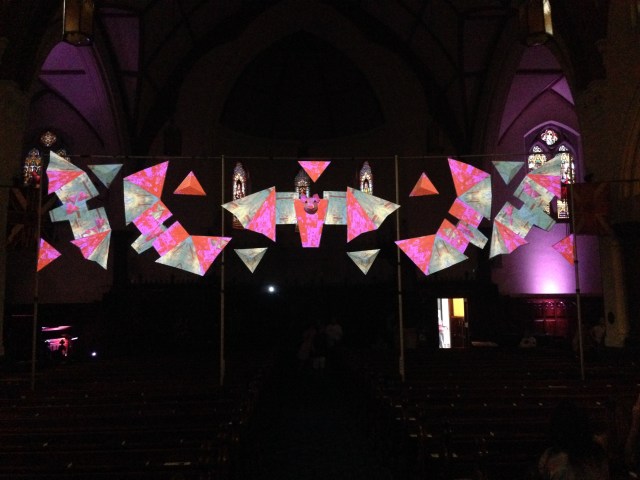
Last Saturday night, White Night took over the city of Melbourne, filling every street and laneway with light, sound and movement. I set out to discover Alinta Krauth’s work Colonise in the heritage listed Scots Church.
It was a relief to escape the hot summer’s night and enter the cool sandstone confines of the church. Inside the dimly lit interior, Krauth’s bat-winged shapes spread across the aisles, hovering off poles suspended over wooden pews. Reassembled on site the ‘bats’ were constructed by Krauth from recycled foam core and paper. The shapes created by the crisp outline of the wings echoed the church’s vaulted ceiling panels and were lit in hues of red and blue like that of the stained glass windows.
Krauth used 360° projection mapping to illuminate each side of the work. The projected images comprised of a montage of mosaic patterns with snatches of the sky, trees and overlays of text. Although it was difficult to decipher Krauth described the text as grabs of commentary referring to the often uneasy relationship between people and bats in urban areas.
Krauth’s art practice is concerned with environmental issues; Colonise highlights the problem of deteriorating natural habitats that are increasingly under pressure from urban development. The site of this work at Scot’s Church offered up a symbolic place of refuge for the colony of Flying Foxes, and also alluded to broader notions of pastoral care.
The concept of refuge was emphasized by the strikingly sparse audio work composed by Krauth, inspired by the music of John Cage. Krauth developed the composition for Colonise using rivers as maps for the audio. The meanders and bends of the rivers were used to generate sound, in a process linking nature, art, music and technology.
As I stepped out of the church back to the hustle and bustle of White Night, Colonise had offered a moment of quite reflection amongst the swirling city lights.
Kerry
Images: Alinta Krauth, Colonise (2015), installation view Scots Church, White Night Melbourne.
Review: Amigurumi Toyland, BrisAsia Festival
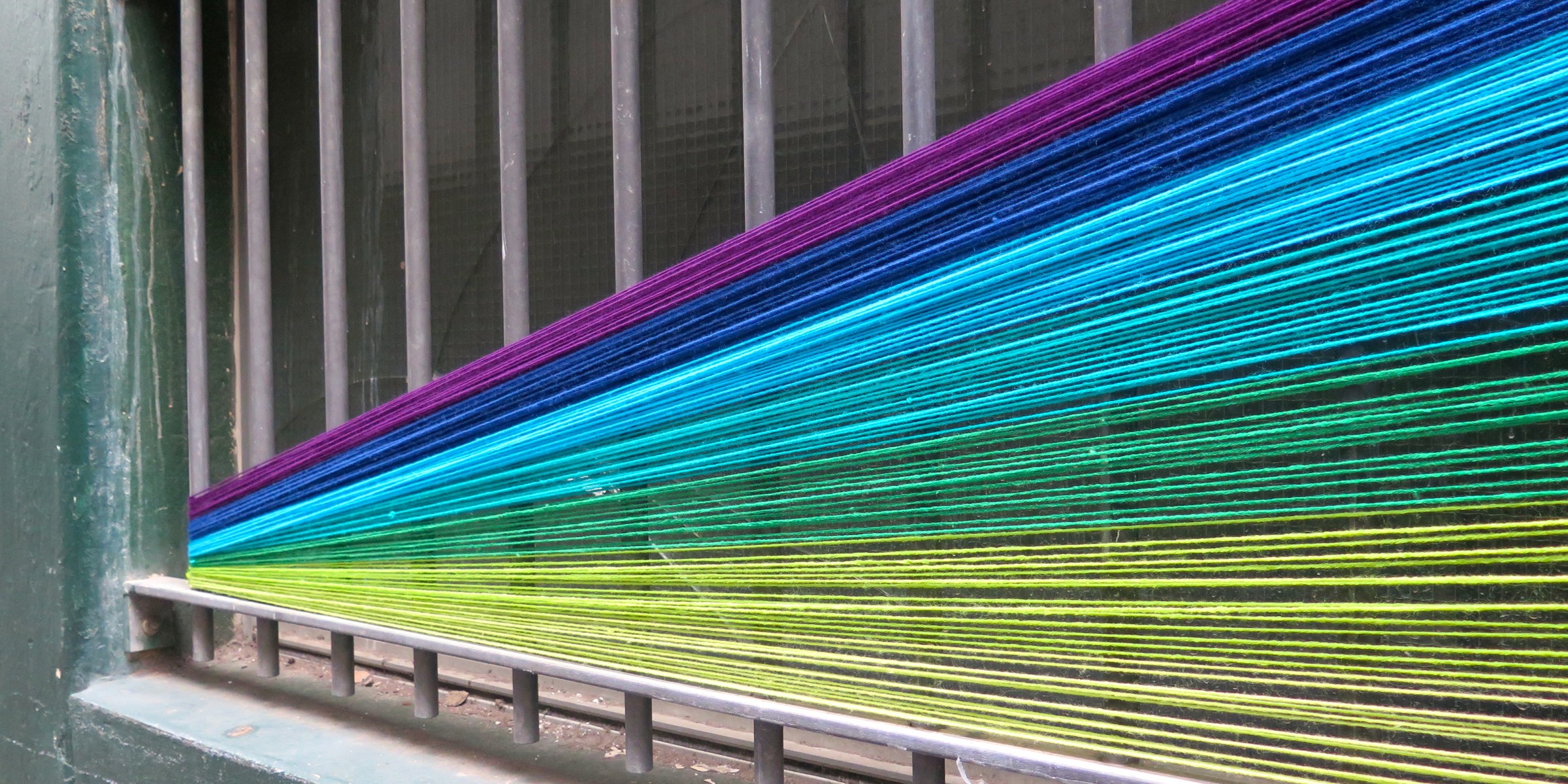
Japan is well known for its culture of kawaii (cute) collectables and animated characters. Amigurumi is the Japanese art of knitting and crocheting small stuffed animals, dolls and anthropomorphic creatures. Much like many Japanese kawaii trends before it, amigurumi has taken off around the globe.
Brisbane-based artist Joon-Yee Kwok creates experiences in public spaces that challenge how we interact with the city by playing on serendipity. Kowk’s lated work, Amigurumi Toyland is a street art project created for BrisAsia Festival that combines the contemporary craft sensation of yarn bombing with the art of amigurumi. The playful installation gives new life to Burnett Lane, one of Brisbane’s oldest laneways.
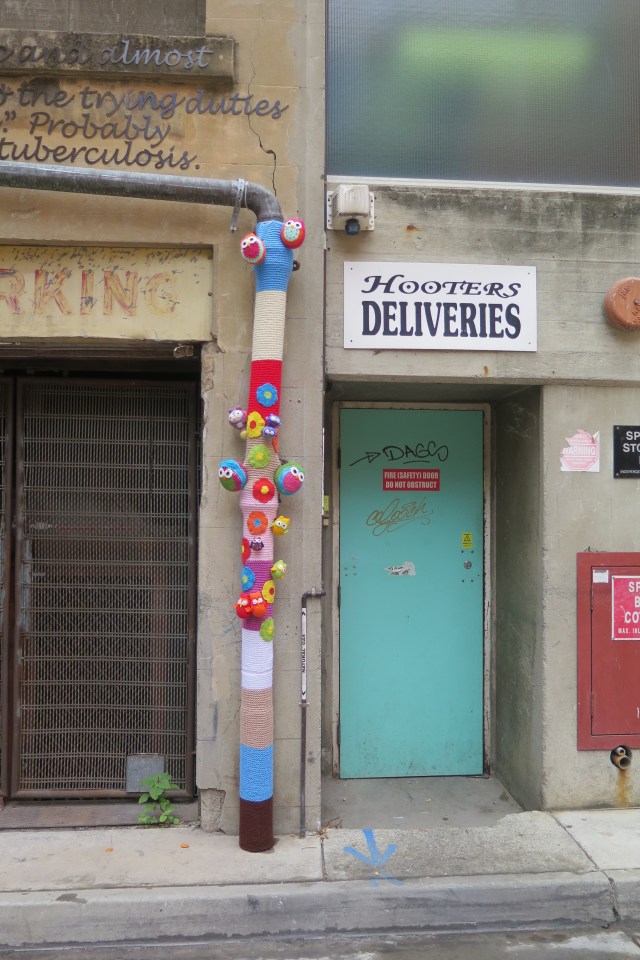
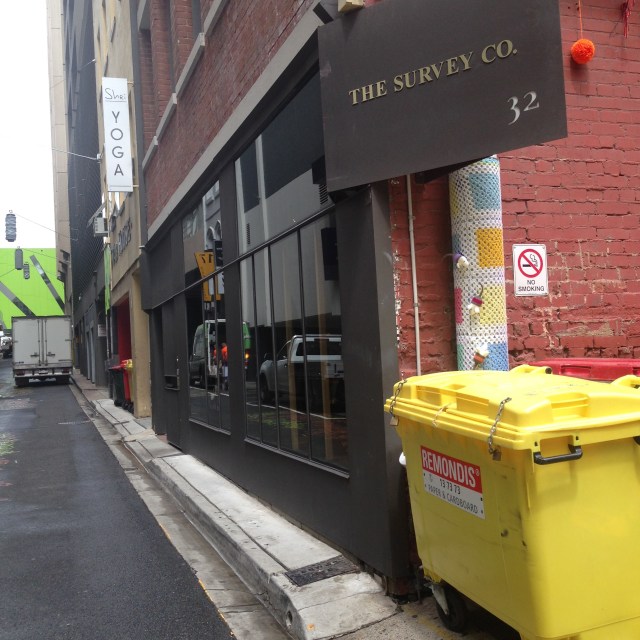
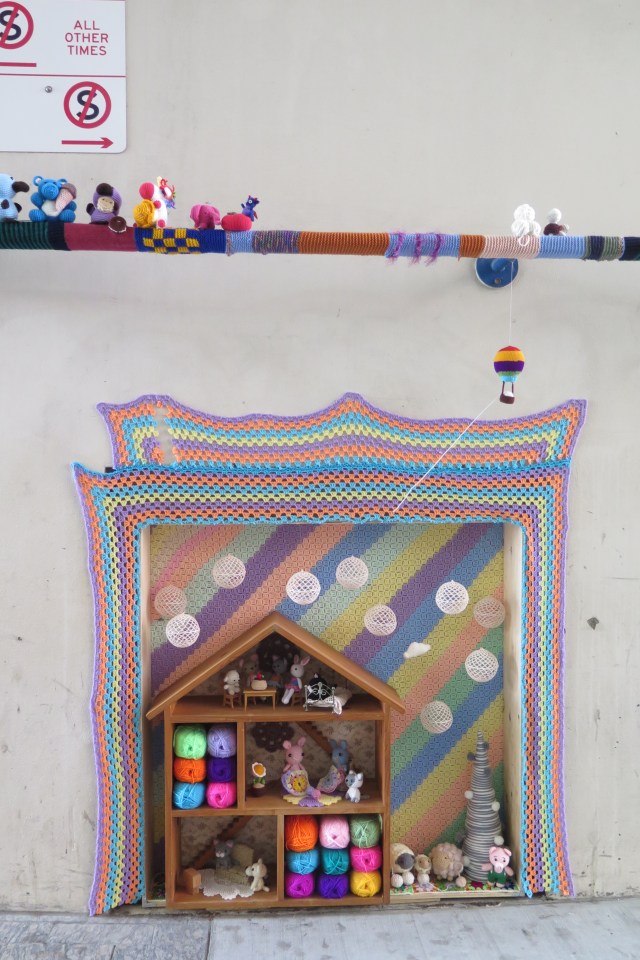
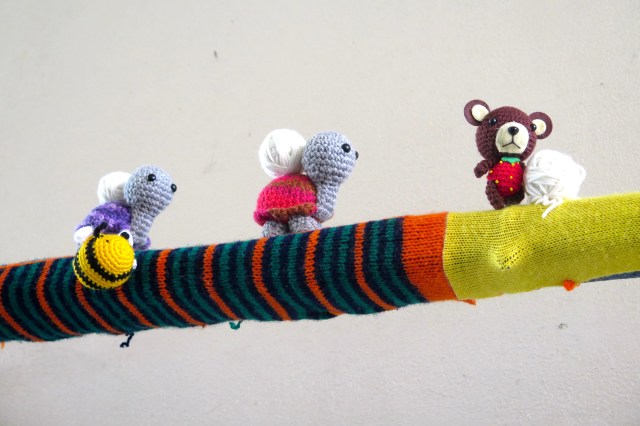
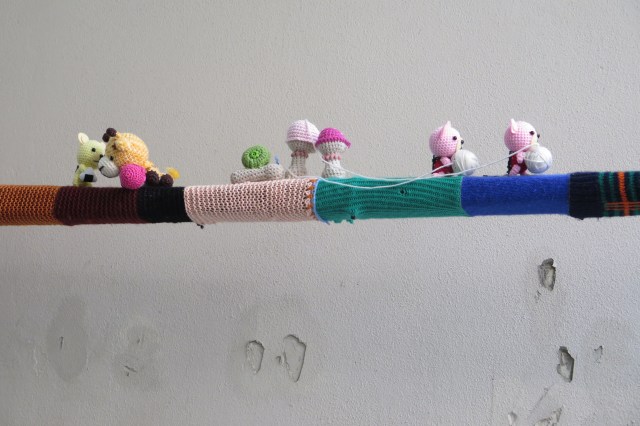
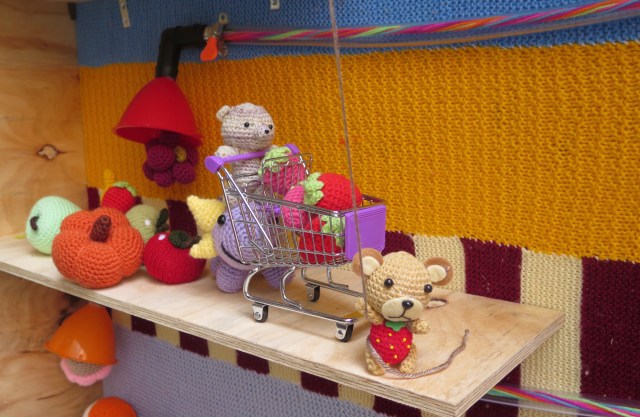
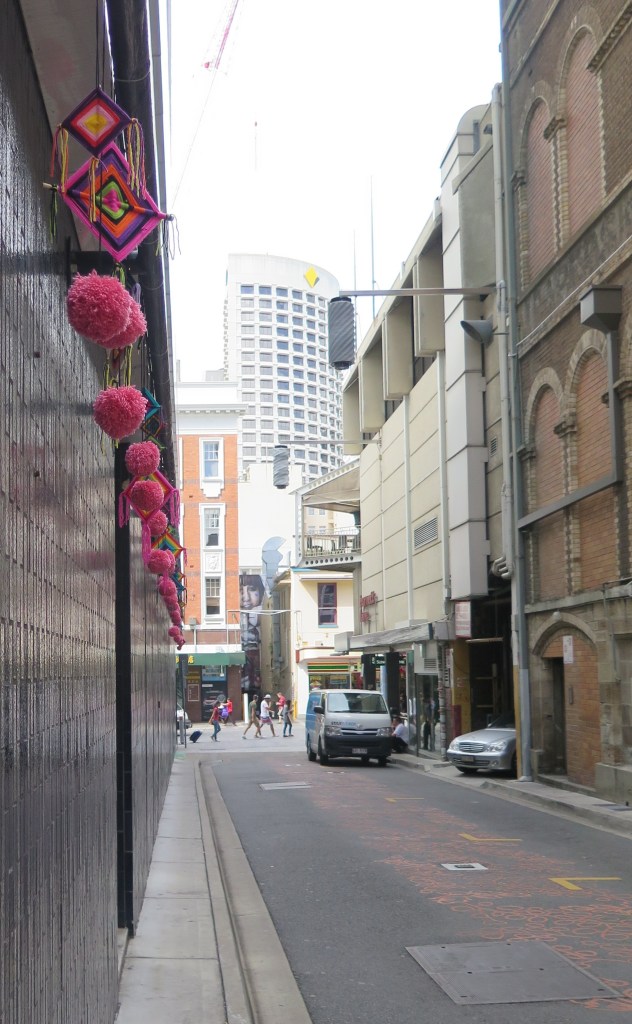
Amongst the busyness of the city, peaks of colourful croqueted pieces placed on metal bollards along Albert Street drew my attention to Burnett Lane. As I was welcomed by subtle flutters of colour hanging against the cold, dark tiles of the lane I was intrigued to see more. As I made my way down the laneway, small crafted hedgehogs, mushrooms, puppies, and teddy bears popped up in unexpected places. I began to notice the adorable stuffed creatures told a story of a factory that made amigurumi objects. Each amigurumi creature played an individual role in the making process of the knitted objects found throughout the lane-way, from placing the yarn into tubes that churn out new toys, to taking the finished products to their final destination. The story told through Amigurumi Toyland gave the installation a surprising touch that encouraged me to explore the creatures closer to discover what other secrets they revealed.
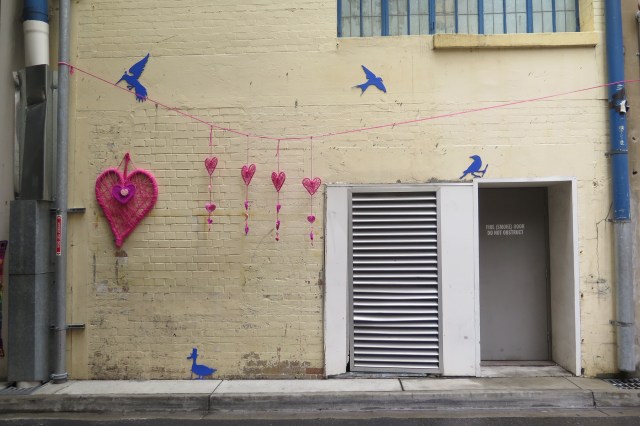
Amigurumi Toyland contains many contrasting elements that transform and alter our experience of the otherwise uninviting space of Burnett Lane. Kowk plays on the juxtaposition of the urban environment and Japanese craft brilliantly. The contrast of bright colours against the metal greys and dull browns of Burnett Lane grabbed my attention. The soft texture of the yarn and wool against the rough, abrasive walls made me feel at ease in the in gloomy space. Most interestingly, Kowk seemed to play on the relationship between the amigurumi creatures and existing objects in the laneway. Big-eyed owls floated nearby an old ‘Hooter’s Deliveries’ sign, knitted mice scurried up a pole near waste bins, and hanging hearts were placed near an existing artwork of birds complimenting the idea of freedom and love that the birds represent. These juxtapositions reinvent the space into an engaging cultural experience that can be enjoyed and excite visitors of all ages.
Amigurumi Toyland revealed a secret that brightened up the city of Brisbane. It reminded me to not get caught up in the busyness of the CBD but to stop, breath and take in the little wonders it has to offer.
Here are some photos for those of you who missed out!




 Engage Arts
You must be logged in to post a comment.