
In The Spotlight: Alinta Krauth
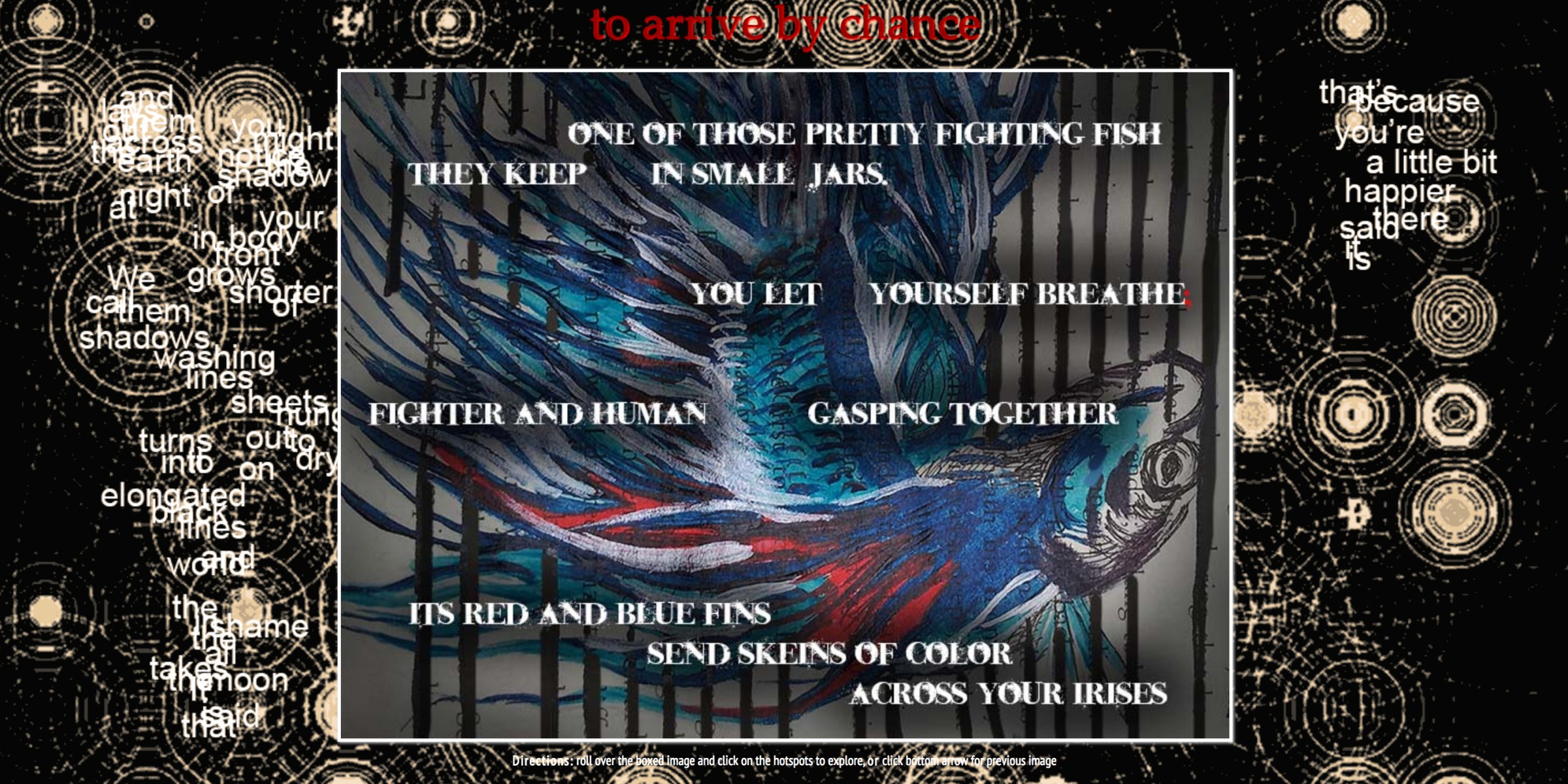
Alinta Krauth is a Queensland digital and new media artist who has exhibited widely across Australia. Her complex site-specific installations create connections between previously unrelated ideas and objects. Krauth’s incorporation of numerous media such as the moving image, audio, computer code and interactive elements attempt to engage the senses and trigger heightened emotional conditions.
Krauth uses various platforms to display her interactive works. Her digital artwork and literature piece, to arrive by chance (Version 1) (2014), uses HTML5 technology run on a desktop, tablet or touchscreen. This interactive artwork prompts viewers to navigate themselves through a web of hyperlinks, exploring four poems on naivety and human dysfunction. As the viewer navigates through the links they generate a unique poem curated by the viewers uninformed choice. Chance plays a key role in constructing the viewer’s individual experience of the work as the viewer steers themselves through the labyrinth of unidentified hyperlinks. Krauth combines visual and aural environments with viewer interaction to explore how the user affects the meaning and experience of the poetry.
to arrive by chance makes its Australian debut as part of the 2015 Queensland Regional Art Awards (QRAA) touring exhibition facilitated by Flying Arts Alliance Inc. The exhibition opens in Brisbane at the Judith Wright Centre of Contemporary Arts on the 7th of February before traveling around the nation. I recently spoke to Krauth about her inspirations and processes.
Can you tell us a little about what inspires your work?
Most of my works have statements – some subtle, some not so subtle – about biodiversity and the environment. I see these as important issues for our health, our economy, and our egos. Our lack of compassion towards others and the ground we walk on raises interesting tensions and complications to explore through a visual and aural narrative. Humans are meant to be intelligent, so it is my hope that we have the ability to learn to respect other creatures and also clean up our own messes. But beyond theme, I think inspiration in general needs two things – a place, and an ability to experiment. And in the end these tend to work hand-in-hand. By place, I mean simply looking around a space, even virtual, and trying to envision an artwork specific for that site. Say you walked into a hat shop and said to yourself, ‘how would I make an artwork that will be shown in here?’ suddenly you arrive at ideas that could only occur in that room.
You work primarily in digital media and technology, yet you also use traditional mediums such as paint and pencil. What the process do you use to combine traditional and digital mediums?
I notice many artists around me are involved in generative art and other types of code art, and in my mind digital art can be so much more than just ‘creative coding’. I’d like to imagine a world where artists can cross genres without question, rather than considering them separate. I notice that some generative art and creative coding can feel quite cold and distant – it’s a nice experiment with technology, but you can’t necessarily see the heart or hand of the artist. By mixing traditional media into my work, I like to think I am giving it a personal touch – a signature brushstroke. I suppose I also find traditional media to be more enjoyable to use. An afternoon of painting is often therapeutic, whereas an afternoon of staring at a computer screen can be stressful. So while my final products are almost always digital, they often rely on my limited human skill to create each page and each character, rather than allowing the computer that privilege. The process involves a lot of scanning in/photographing drawings of characters in order to digitally alter them. I don’t outsource any of my process, so each step of my work remains personal. I’ve also recently started to incorporate sculpture and 20th century hardware into my installation works – it’s nice to be using my hands in so many different ways to make art.
As a digital interactive, to arrive by chance can be experienced anywhere with a connected device, but you also display it in the traditional gallery space. Ultimately, the work could completely disregard the gallery space and rely solely on Internet viewing. Do you think that these different locations for viewing affect the participant’s involvement with the work?
That’s a good question. Being an online work, I don’t get to see the reactions of many of to arrive by chance’s viewers. But this piece originated as a set of four poems, which are turned into a choose-your-own-adventure html piece, so I imagine it as akin to people reading the same book all over the world – their reflections and connections will be dependent on their situation. My honours thesis at university was partially about the connection between the human and the computer screen – the contrast of closeness and anonymity that can occur through the Internet, and how this is evident in online creative writing. I think this affects Internet artworks because, rather than the large room and public nature of a gallery, people sit in their own space and have a one-to-one connection with the work without self-consciousness, and perhaps to an extent without self-awareness.
The audience is central to your work The desire to inform. You encourage viewers to touch, hear and see. Can you describe how encouraging viewers to use multiple senses impacts their experience of your work?
All my works involve sound, sight, and to some extent, touch. They’d also include smell, taste, equilibrioception (sense of balance), and proprioception (body movement in response to stimuli) if it were possible. I think using multiple senses helps the viewer to be consumed by the interaction; it also makes the viewer aware or unaware of themselves in unexpected ways. It involves their bodies as well as their thoughts. Human culture is full of multimodal story telling, and online culture is now accustomed to experiencing sound, text, moving image, and gesture interaction all at the same time. It is in our nature to consider the world through all of our senses. Online artworks, much like computer games, tend to be a little other-worldly, and like an astronaut setting foot on another planet, there are many unknown aspects that you are required to explore and find, so you need to be open to unexpected sensory stimulation.
We are excited to follow your upcoming projects. Can you tell us a little about any new projects are you working on?
I’m hoping to start experimenting more with sensor-based works and reactable paints. I’m particularly interested in how aural stimulation affects proprioception, so I’m looking for an opportunity to incorporate that into my work. I have another visual poetry html piece out called if-Not-now, if then-when-else, which is a comment on climate change using code poetry. You can test it out at www.alintakrauth.com/ifthen (again, remember to have your speakers on). I also have an art/poetry game soon to be available through the app store called An Argument in Parallel Incompleteness – www.alintakrauth.com/an-argument. This is another piece that has been shown several times in galleries and festivals, including the upcoming Currents Festival in New Mexico, USA, so it tiptoes that line between the online world and the real world. I’m also doing a couple of larger installation works focused on projection mapping. One for White Night Melbourne entitled Colonise, and one for the Brisbane Powerhouse in May/June called Un[tram]melled. For the next few weeks you can also see my projection mapping work across the wall of local venue The Depo in West End. Also stay tuned for a piece in the Ipswich Regional Gallery later in the year. I’m very excited to see local and regional venues opening their doors to interactive works, and it is thrilling to be at the forefront of this shift in Brisbane.
Thanks for your time Alinta! We are very excited to check out Alinta’s intriguing work at the QRAA and White Night Melbourne. For more information about the QRAA visit Flying Arts‘ website. Find out more about Alinta’s work and upcoming projects at www.alintakrauth.com.
Image: Alinta Krauth, to arrive by chance, 2014, (screenshot), courtesy of artist.
2015 The International Year of Light
It is undeniable that light plays a significant role in our everyday lives. It allows us to sustain agricultural growth and maintain our wellbeing. To put it simply – without light, life stops.
The United Nations has declared 2015 The International Year of Light and Light-based Technologies (ILY 2015). ILY 2015 aims to showcase how light-based technologies can contribute to sustainable development and provide solutions to global challenges in energy, education, agriculture and health.
UNSECO has banded together with scientists, artists, designers, educators and politicians from around the globe to raise global awareness about the importance of light. As you can imagine, this has produced some very creative projects; think illuminated buildings and laneways, light shows and interactive installations lighting up streets around the world. I’ll shine the spotlight on ILY 2015 projects and showcase artists whose interactive work makes them luminaries in art and technology.
I look forward to sharing the voyage of light on Engage Arts blog!
Danielle
Summer Reading
Over the long Queensland summer I have been reading Charles Landry’s inspirational book, The Creative City, A Toolkit for Urban Innovators. Landry discusses how we can all, “think, plan and act creatively to make our cities more livable”. While many of the books case studies focus on European projects, we want to apply these concepts at Engage Arts to foster inspirational urban experiences designed in creative collaboration in our cities and spaces. As Landry says, “every crevice in the city had a hidden story or undiscovered potential that could be re-used for a positive urban purpose”.
Here is the book reference for anyone interested in further urban inspiration –
Landry, C 2000, The Creative City, A Toolkit for Urban Innovators, Comedia, Earthscan.
 Engage Arts
You must be logged in to post a comment.