
In the Spotlight: Freya Pitt
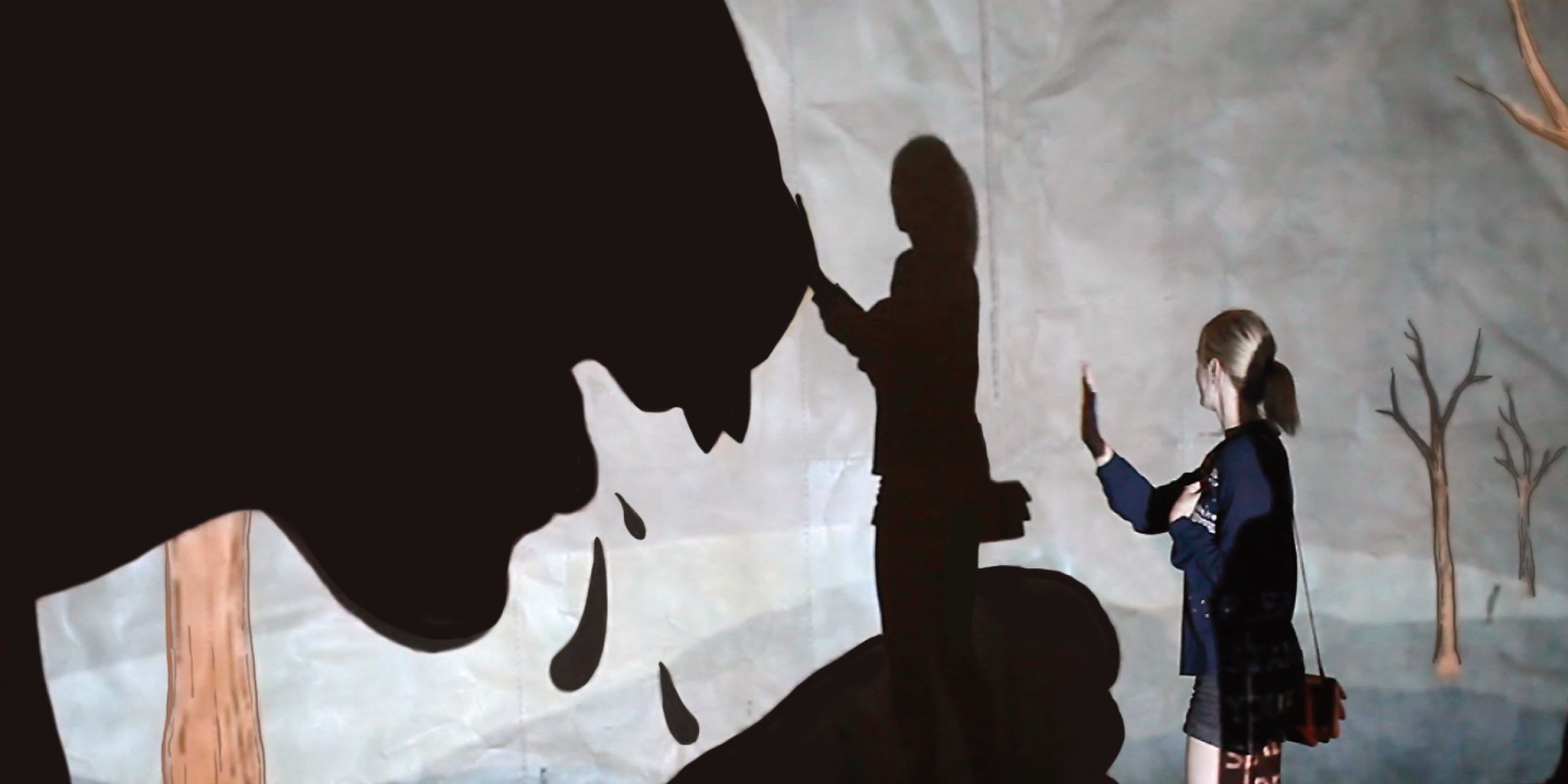
Freya Pitt is a Melbourne-based projection artist who is taking the art world by storm. She combines beautiful hand-drawn illustrations with projection installations, shadow puppetry and manipulation to examine how different people react to the environment around them.
Pitt’s passion for drawing started as a young child and has stayed with her ever since. She grew up in Western Australia and graduated from the Edith Cowan University in 2009 before moving to Melbourne to complete a Masters of Art in Public Spaces at RMIT University. Her whimsical silhouette works have featured in public spaces both internationally and around Australia including the Melbourne Art Tram Project, White Night Melbourne and the Gertrude Projection Festival.
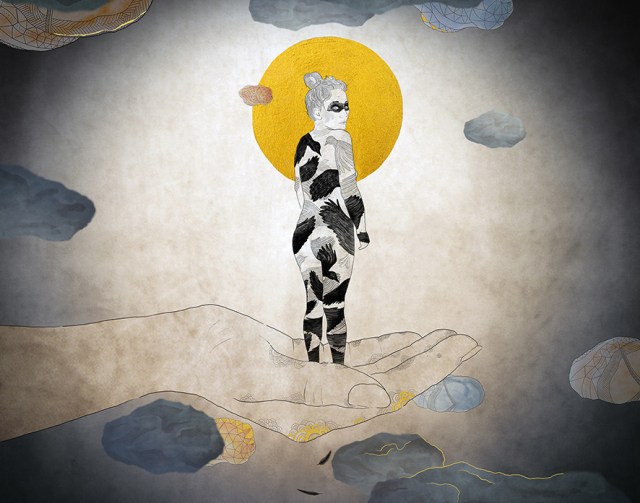
Freya Pitt, ‘Desire; A Story of Hands’, 2014. Courtesy of the artist.
Pitt’s fascination with paper-cuts, silhouettes and shadows led her to experiment with overhead projectors early in her creative practice. Such experiments ultimately formed the basis of her signature large-scale, interactive projection installations that spill onto public spaces. She draws on pop-culture, mythology, fables and classical texts, to create magical environments that tell a story through animated illustrations, text, illumination and shadows. Viewers are invited to become apart of the work by standing in a designated spot so that their shadow becomes the main character in the projected narrative. Each viewer brings their own personality to Pitt’s work; it’s simply fascinating to watch (and so much fun to be a part of)!

Freya Pitt, ‘An Infinitesimal Pause ‘ (still), 2014. Courtesy of the artist.
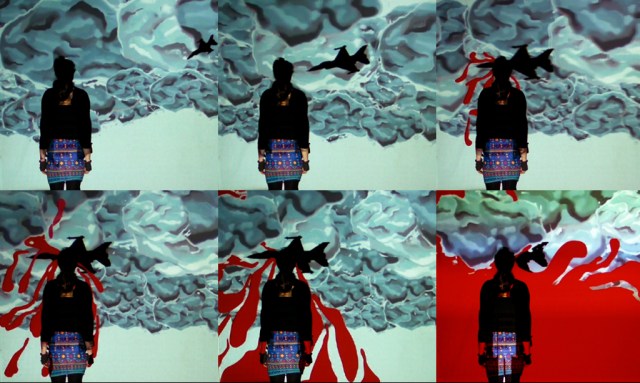
Freya Pitt, ‘The beat in my chest and yours’ (still), 2012. Courtesy of artist.
Pitt’s work The Skies Are on the Ground created for the 2014 White Night Melbourne Festival is a great example of this (watch a video of the work in action here!). The viewer becomes a part of a mystical world that features hand-dawn animated mythological creatures and Gods. In this work the viewer’s shadow becomes a central character in the narrative. Throughout different scenes, viewers become winged creatures, attacked by giant fish, float in a world of pink clouds and face evil powers. What makes Pitt’s work so intriguing is that every participator reacts differently, manipulating the narrative so that everyone tells a different story. Some participators choose to fall victim of the mystical beasts in front of them, and some vigorously fight against them. Pitt’s wild imagination takes both the viewer and the participator on a journey that is both unique to the individual and transforms the use of public spaces into a completely new world.
I recently chatted to Pitt about her work (and her responses are just as fun as her work!):
D: Can you tell us about the ethos and inspiration behind your work?
F: I find the world both confusing and fascinating, and my art tends to come out the ensuing curiosity. I like making things that are engaging and accessible yet not didactic – this is an attempt to pull the viewer into a constructed world, and then encourage them to question their relationship to it.
I think the beauty and the difficulty of the world is in its complexity, and I want to playfully draw people into considering the way they interact with it in a manner that gives them a sense of agency.
D: What inspired you to work with shadow puppetry and manipulation?
F: I had already been working with paper-cut’s in installations, and shadow puppetry seemed like a natural way to add movement and narrative, which I quickly became obsessed with. There’s a power in the interplay between shadow and light that I find endlessly alluring.
D: Your projections incorporate traditional hand drawn elements. Can you tell us about the process of digitally animating your illustrations? How long does it take to animate a piece like ‘The Skies Are On The Ground’?
Yes, the lo-fi aesthetic is important to me, in keeping a sense of human connection. Sometimes the hand drawn elements are first penned/painted on paper, then photographed and worked with digitally, and sometimes drawn digitally using Wacom tablets. I use a combination of Adobe programs to put the works together. As a self-taught animator my processes often seem convoluted to those trained to use the programs, and while I’m always excited to learn more I think the made-up ways I’ve done things have given the works their own aesthetic that can be interesting unto itself.
I think I was working on ‘The Skies Are On The Ground’ for around three months, though a lot of that time was spent on concept development and I would have loved to get more time to animate. I tend to be deadline driven, and don’t think I’ve ever felt that a work was ‘finished’ when it’s been shown!
D: Your work plays heavily on storytelling and imagination. What do you aim to achieve through your narratives?
Stories are the love of my life. They are such an important part of the way we make sense of the world. Our very sense of self is a story we tell ourselves, albeit one constantly in flux and impossible to write down in its entirety.
I try to use narrative to interrupt or augment viewers everyday sense of self, and explore the constant shifting of relationships and meaning.
D: When I see viewers react to works like ‘The Skies Are On The Ground’ at White Night Melbourne Festival 2014, it reminds me of an interpretive dance; viewers dramatically twist and pop their bodies in response to the projection before them. What’s the best reaction you’ve seen to your work?
F: Yes, your own shadow can be surprisingly engaging, and I love watching the different ways people interact. It’s tough to pick a favorite, though one little boy at the 2014 White Night was pretty memorable. He was totally mesmerized by his shadow within the moving projection, and after slowly moving closer ended up licking the lit-up wall. While maybe unhygienic, the moment captured what I see as the desire inherent in projection. Similar to stories and mythology, it can offer delicious possibilities that you can never quite touch, and the poetics of this can make us do strange and wonderful things.
D: How can we keep up-to-date with all things Freya Pitt?
F: Well, I do the usual Instagram (@freyapitt), Facebook (Freya Pitt Artist) and website (www.freyapitt.com), and am constantly promising myself I’ll spend more time updating them.
– Danielle
Feature image: Freya Pitt, The Beasts from Behind (Still), 2013. Image courtesy of the artist.
Review: GOMA Q at GOMA

If I want to see contemporary Queensland art, I usually plan a trip to a local University art museum or an artist run initiative. So when I found out the Gallery of Modern Art (GOMA) was curating an exhibition of contemporary Queensland artists, I was a somewhat surprised. As Queensland’s leading contemporary art institution, GOMA is better known for drawing people in with its blockbuster international exhibitions such as the Asia Pacific Triennial, rather than its focus on contemporary Queensland art practice. Excited at the prospect of seeing an exhibition comprising solely contemporary Queensland artists in our major modern art institution, I set off to see GOMA Q: Contemporary Queensland Art shortly after it opened.
This inaugural GOMA Q exhibition is the first in a series of exhibitions that responds to common criticism that QAGOMA lacked a strong focus on current Queensland artists. During the lead up to the exhibition, Chris Saines, Director of GOMA, and curators Peter McKay and Bruce McLean visited around 200 studios to gain a deeper understanding of the current Queensland art landscape. The result: a timely exhibition that showcases local talent, both big and small, and the nature of Queensland art today.
I walked into GOMA Q without much prior knowledge of the exhibition. I expected the curators to show well-known and established Queensland artists that you can often see in major galleries around Australia. Rather, I was challenged by a diverse, and refreshing, range of emerging and established artists from both regional and urban Queensland. I was particularly impressed by the quantity of exhibiting emerging artists like Clark Beaumont, Monica Tohan, Liam O’Brien, Teho Ropeyarn, Dale Harding, and Tyza Steward.
Monica Rohan is an emerging artists and one of Brisbane’s rising stars who is already represented by Jan Murphy Gallery, Brisbane and Sophie Gannon Gallery, Melbourne. Her beautifully rendered and intricate paintings aim to visually communicate what it feels like to be overwhelmed. Her paintings convey female figures twisted in chaotic and colourfully patterned quilts that seem to weigh the figures down. The juxtaposition between the beautiful, delicate quits and the obvious struggle of the figures creates a sense of tension and suffocation. It’s not surprising that these strikingly beautiful works front the GOMA Q catalogue!
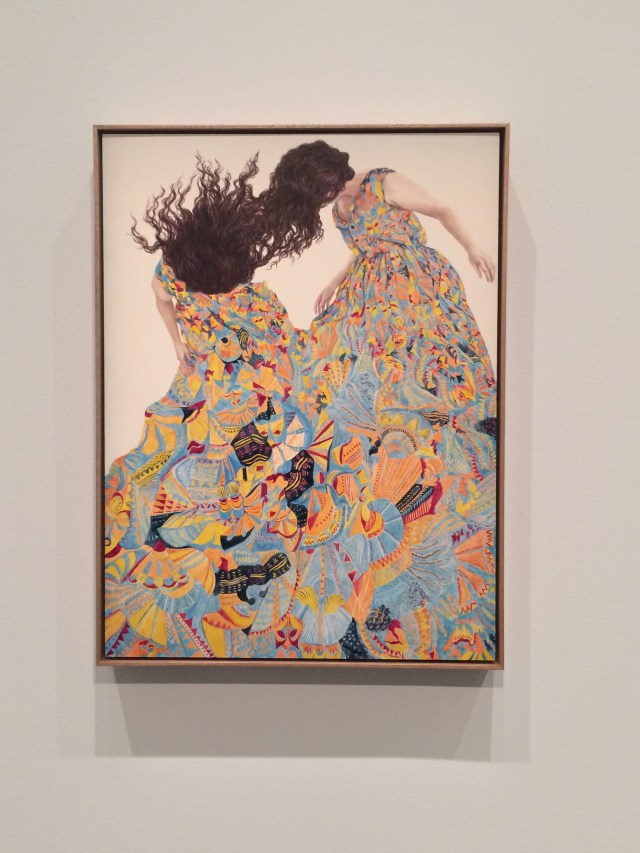
Monica Rohan, ‘Bluster’, 2015. Oil on board. Rohan is represented by Jan Murphy Gallery and Sophie Gannon. Image taken at the exhibition.
The proliferation of highly talented Queensland Indigenous artists is evident with a strong Indigenous representation at GOMQ Q. One of my favourite works is Vernon Ah Kee’s acontentedslave (2015), which is part of his shield surfboards series. Ah Kee started creating shield surfboards as a response to the 2005 Cronulla riots. acontentedslave looks at dehumanisation throughout the history of slavery. A group of six surfboards float in the gallery space. On one side you can see bold Indigenous markings against a red background; on the other side is large, disjointed text that tells a confronting quote by Frederick Douglass. Ah Kee’s work chillingly highlights racial attitudes towards slavery in the 1800s and reminds us of racial landscapes that still affect many today.
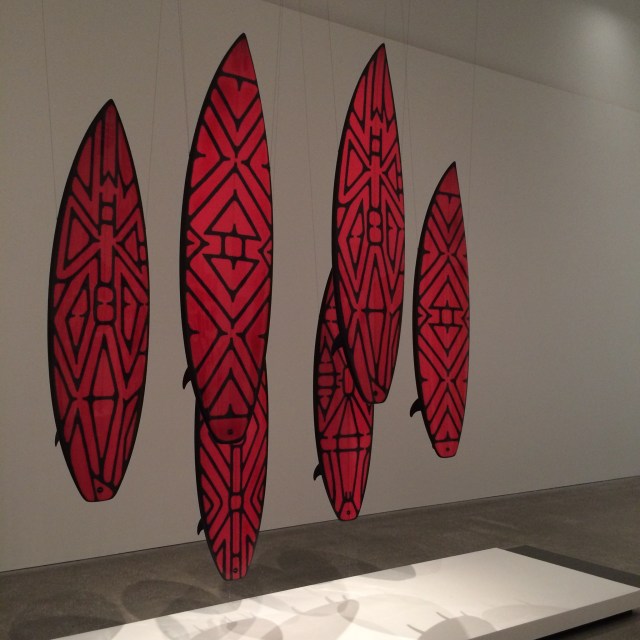
Vernon Ah Kee, ‘acontentedslave’, 2015. Synthetic polymer paint and resin over digital print on foamcore. Ah Kee is represented by the Milani Gallery. Image taken at the exhibition.

Vernon Ah Kee, ‘acontentedslave’, 2015. Synthetic polymer paint and resin over digital print on foamcore. Ah Kee is represented by the Milani Gallery. Image taken at the exhibition.
The boldness of work by emerging Indigenous artist, Teho Ropeyarn also stood out. Ropeyarn is from the Injinoo community based in the Northern Peninsula Area of Cape York. His large-scale, bold linocuts and vinyl relief prints bring a contemporary edge to stories, old knowledge and ceremonial designs passed down from the Injinoo Elders.
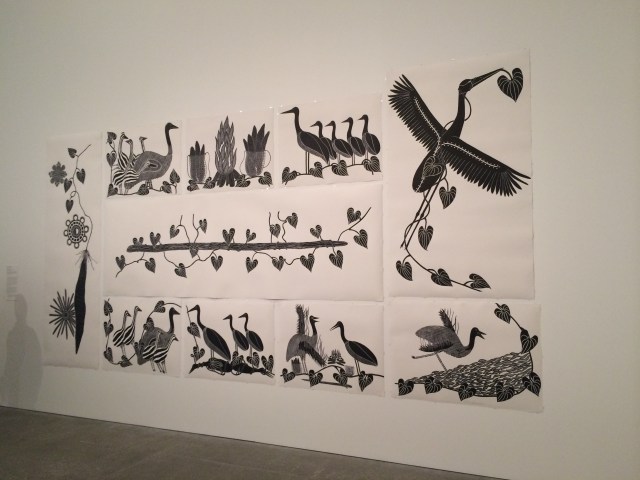
Teho Ropeyarn, ‘Utku an Alarrakudhi – Anbachama lkya (Emu and Brolga – beforetime story)’, 2014. Vinyl-cut print on vein cube 350gsm, ed. of 15. Printed by Theodore Tremblay. Image taken at the exhibition.
Of course, the exhibition would not be complete without well-known Brisbane artist Michael Zavros’s photographic-like paintings. His works are always rendered with such realism; he captures light so accurately, they are absolutely breathtaking. Even at close hand, it’s hard to believe that Zavro’s portrait of his daughter Phoebe is Eight/ Tom Ford (2013) is actually an oil painting. In his artist statement, Zavros describes Phoebe’s direction in their shared portraiture sessions, confirming his daughter’s strong personality that shines through in this portrait.

Michael Zavros, ‘Phoebe is Eight/Tom Ford’, 2013. Oil on board. Private collection, Sydney. Image taken at the exhibition
GOMA Q did not assert unifying curatorial themes. Instead, the exhibition simply offers insight into a slice of Queensland’s talented practicing artists. The display of contemporary Queensland artists is important in and of itself, and what this exhibition really does is encourage important discussions around how Queensland needs to show more support and nurture its talented artists. An exhibition like GOMQ Q in Queensland’s leading institution builds a new audience for the state’s artists, while strengthening Queensland’s creative landscape. If you’re a Queenslander, I recommend visiting this exhibition; after all, there’s nothing more refreshing and inspiring than seeing what’s going on in your own backyard. If you’re visiting Queensland from overseas and interstate, come and see what Queensland has to offer.
You can catch GOMA Q at QAGOMA until 11 Oct 2015. For more information click here.
– Danielle
Photography was allowed in this exhibition. All works attributed to artists
Small Scale Stories – Part 2, Interview with Maria Flourou
Mobile photographer Maria Flourou kindly agreed to chat to Engage Arts for our Small Scale blog post Part 2. Maria shares her thoughts on Instagram and reveals some of the techniques she uses to create her layered photographic works.
Kerry: What inspires your photography?
Maria: Life, dreams and escapism.
Kerry: Instagram has become a great place to discover artists and their work, what made you join Instagram and why do you like it as a platform?
Maria: I had been introduced to it by a friend and was only using it to post odd pics from around home. I then stumbled across other functions and kept noticing how good some of the other art works were. There are some inspirational artists out there! That said, I wondered how such great things were achieved. I remember reading comments and slowly I picked up the name of various apps, downloaded them and taught myself how to use them. It’s such an amazing app (Instagram), I’ve met some fantastic people through it. This is how the Mnemonics began.
Kerry: Many of your works have a dream-like quality and are visually layered, can you describe a little of your process in constructing an image?
Maria: You’ve described it well! Ideas do come to me like a dream, fleeting thoughts and escapism, especially when things are consuming my thoughts and I need a release. Once the photos are taken, it is then put through various apps. Firstly, I usually clean up the native image taken by my iPhone with Snapseed, then I may blur parts or delete areas of the image with either Blurfx, Art Rage or Repix. I use Blender to combine another part of an image to it and then usually like to finish with varying the tone and adding texture with either Mextures, Picture Show or Scratch Cam.
Kerry: You also belong to an online ensemble of artists the mnemonics, what is the idea behind this group?
Maria: We all came across each other’s work on Instagram, shared a lot in common and genuinely enjoyed each other’s company. We share a love for photo taking, story-telling and art. Though all our own personal styles are unique, we combine all of these elements when we work. We are all based around Australia so we have all been able to meet and stay in touch. We had our first group exhibition last year as featured artists at the Head On festival in Sydney. ‘Memoria’ was a hit and lots of prints were sold. We are talking at the moment about what our next venture will be and where? Stay tuned!
Kerry: Your work, Dreams of a Boy was recently entered into the Lethbridge Gallery’s small scale art award and you have exhibited at the Head On Photo Festival in Sydney. What are some of the challenges of preparing a mobile work for an analog exhibition?
Maria: The only challenge when I need to change my digital works into analog, is sizing. When you are only shooting with an iPhone/mobile device you are restricted by how far you can enlarge an image. There are also great apps for that to like Squaready. Finding a great and affordable processing lab is also important. They can also increase the dpi before printing and are very experienced with recommending the right paper for your desired look. I use Allchrome in Wilston, Brisbane.
Thank you so much for chatting to us Maria! You can follow Maria Flourou’s work on her Instagram feed @muzbanger and also @calipso. Check out the photography collective the Mnemonics. All images courtesy of the artist.
– Kerry


 Engage Arts
You must be logged in to post a comment.