
In the Spotlight: Vanghoua Anthony Vue
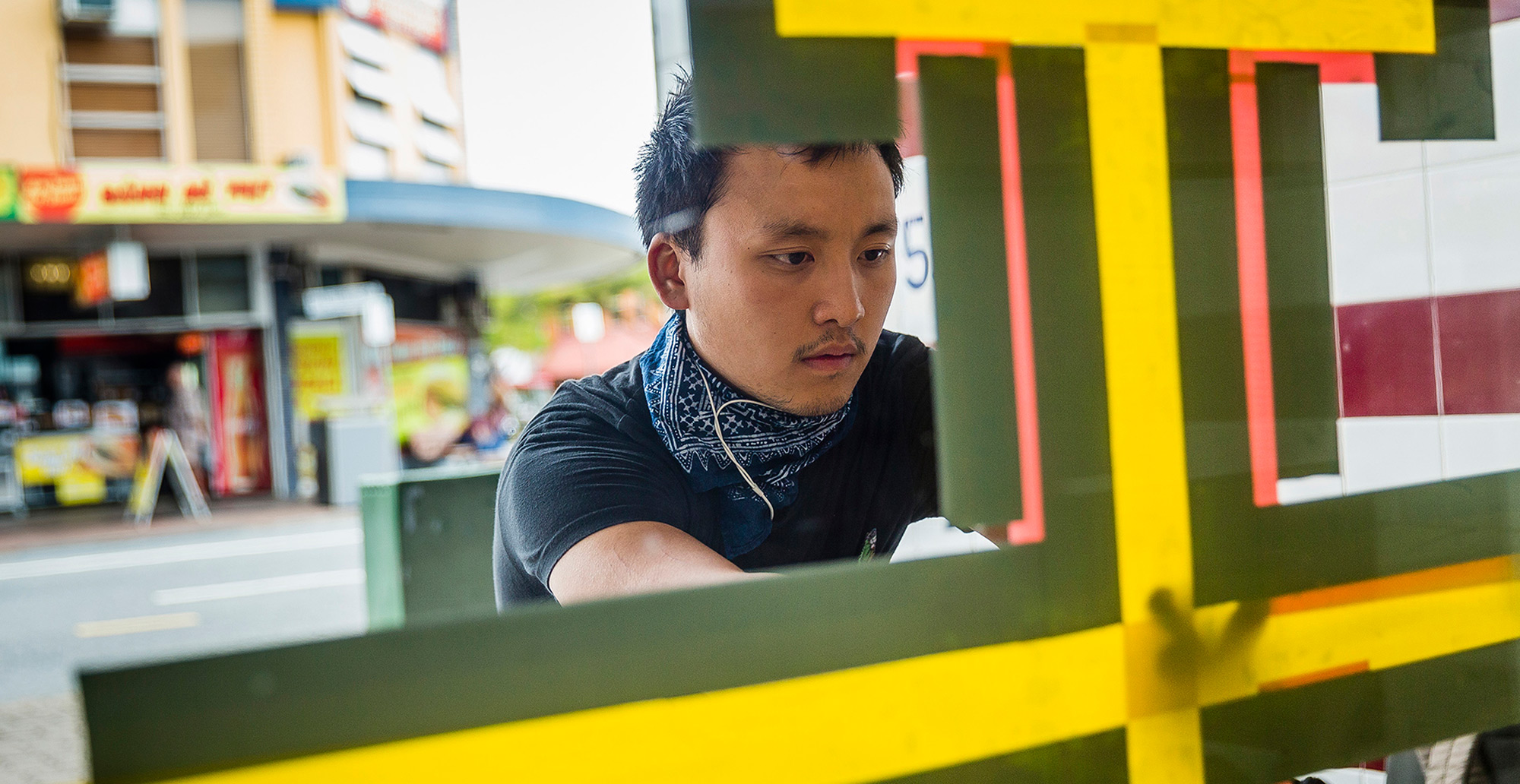
Bringing art outdoors with Queensland’s talented artists is a great way to start 2016. Our first Engage Arts ‘In the Spotlight’ post for this year is with multidisciplinary artist Vanghoua Anthony Vue. Vue and artist Elysha Rei Gould are creating a new works for the BrisAsia Festival, Weaving Our Heritage laneway installation launching in February.
Vue’s art practice encompasses painting, sculpture, drawing, installation, public art and community-based art. Drawing inspiration from popular culture, street art, the everyday, DIY ethic, and art history his work creates a visual dialogue. Vue often re-purposes everyday materials like industrial tapes and creates usual juxtapositions with the use of objects such as mass produced ceramics applied overlaid with Hmong textile patterns.
The use of textile decorative and language systems are based on aspects of Vue’s Hmong heritage, which are interpreted into a contemporary art context. Central to Vue’s practice are explorations into identity and representation, tradition and innovation, diaspora and migration, history and memory. For images of Vue’s studio and public works visit, www.vanghoua-anthonyvue.com.
For the BrisAsia Festival, Vue has created site specific works in the urban context of Eagle Lane in Brisbane’s CBD that make use of language systems, textile traditions and created symbols. Engage Arts will be featuring audio interviews with Vue and Rei in our upcoming posts and we look forward to unveiling their works for Weaving Our Heritage.
- BrisAsia Festival, Friday Night Laneways
- When: 7- 21 February 2016
- Where: Eagle Lane, Brisbane City
- Cost: Free
For further information on the BrisAsia Festival visit www.brisbane.qld.gov.au/whats-brisbane/featured-events/brisasia-festival-2016
Kerry
2015 – what a year!
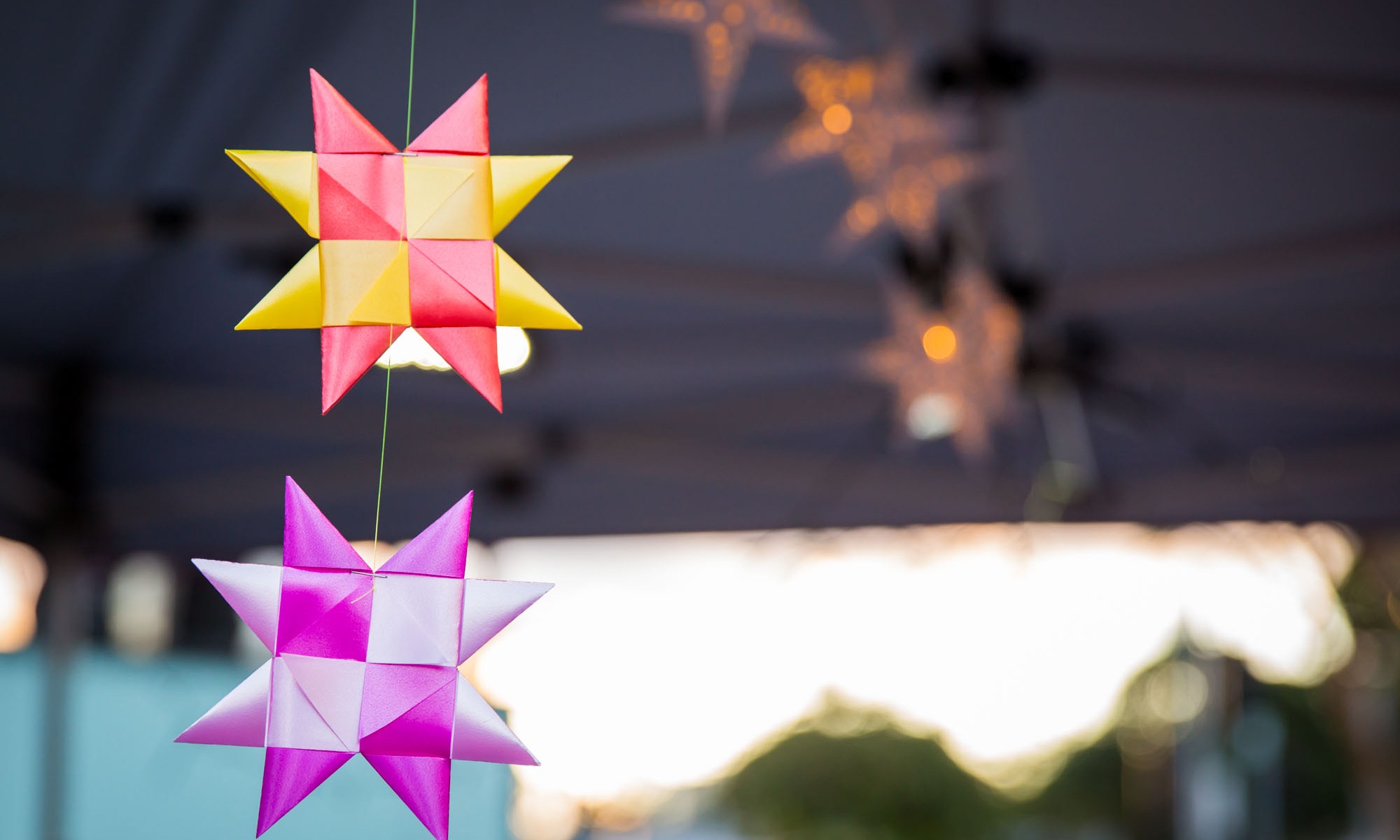
With the holiday season upon us it feels like the right time to reflect on the year that was…
2015 has been a fantastic first year for the Engage Arts team. We’ve produced some exciting projects and collaborated with amazing creative partners. For the International Year of Light we participated in the U.R{BNE} Festival bringing a range of creative projects to life. We organised a 1 Million Stars to End Violence workshop and were proud to produce Alinta Krauth’s projection mapped installation, Wind blisters those who try to run, which shone a light on the Old Windmill at Spring Hill.
Danielle and I worked with a team of curators on Reminiscence, an exhibition and festival celebrating the life of Judith Wright in her centenary year. For this project, Engage Arts was tasked with creating the new ‘Curators in Space’ website for Flying Arts Alliance. You can check it out here: http://curatorsinspace.com/
It was with great pleasure that we profiled over 20 artists on our blog, learning more about the work of so many talented contemporary artists. A big thank you to all of the artists who took the time to answer questions for our ‘In the Spotlight’ blog features – we are glad to have gained insight into your work and shared it with our followers.
Exciting things are just around the corner for Engage Arts. We are kicking off the year with a laneway installation for Brisbane City Council’s BrisAsia Festival and looking forward to taking art to the streets collaborating with the Story City App.
I look forward sharing more engaging art and cultural experiences with you 2016. Have a happy holidays and sparkling New Year.
Kerry
Feature image: Photo from the 1 Million Stars workshop at the 2015 U.R{BNE} Festival. Photo by Anna Osetroff.
‘The Churchie’: highlights from the 2015 Churchie National Emerging Art Prize

Image: Sha Sarwari, ‘National Icon’, 2014. Photographic print. Courtesy of the artist.
For over 28 years the Churchie National Emerging Art Prize (‘the churchie’) has been showcasing Australia’s next major creative talents. It comes to no surprise then that this year’s featured artists keep popping up on our radar! After spotting this year’s winner, Michaela Gleave at the Experimenta Recharge exhibition, Kerry and Danielle thought it was time to reflect on the talented artists exhibited in this year’s ‘the churchie’ prize at Griffith University Art Gallery, Southbank.
Danielle: ‘the churchie’ is dedicated to showcasing innovation and excellence across contemporary, traditional and new media art genres. This year’s prize was judged by Rachel Kent, Chief Curator of the Museum of Contemporary Art (MCA), Sydney. Kent selected Michaela Gleave as the winner of the $15,000 prize (non-acquisitive) sponsored by Brand+Slater Architects, for her performance piece, Waiting For Time (7 Hour Confetti Work) (2014). Gleave’s performance was streamed live from her New York studio to the Gallery of Modern Art in Brisbane on Saturday 10 May 2014. The performance involved the artist setting off a hand-held confetti cannon every minute for seven hours.
Kerry: My take on Gleave’s Waiting For Time (7 Hour Confetti Work) is that it is talks to the endurance aspects of time and the fleeting nature of the viewer’s attention. The artist is subjecting herself to 7 hours of sitting and passing time. In contrast, the viewer can dip in and out making our experience of the performance inherently different. Why has Gleave used confetti bombs to pass the time? It’s fun, colourful and associated with anything but endurance and slow passages of time. Confetti is ephemeral. It is often all that is left when the party is over; it indicates the traces or passing of time.
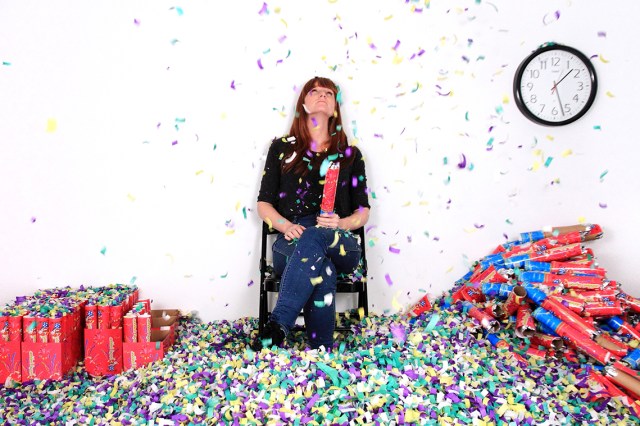
Michaela Gleave, ‘Waiting for Time (7 Hour Confetti Work)’, 2014. Video performance executed via YouTube, 16:9 colour stereo. Courtesy of the artist and Anna Pappas Gallery, Melbourne.
Danielle: This year’s prize certainly offered an intriguing range of works spanning diverse mediums. For me, Sha Sarwari’s National Icon (2012) is one of the most powerful works in this year’s prize. Born in Afghanistan, Sarwari come to Australia as a refugee in 1999 and has since called Brisbane home. He holds a Bachelor of Fine Arts from the Queensland Collage of Art and has exhibited throughout Australia since 2011. National Icon (2014) is a photograph that depicts a young man laying on the beach with his head buried in his arms so that you can’t see his face. The mysterious youth wears an inflated life jacket suggesting he has been travelling on a boat. With no other clues as to who he is, we are left to question his identity.
Kerry: I agree it was a very striking work, using a clear reference to Max Dupain’s iconic image of 1937, The Sunbaker. By referencing such an iconic Australian image, Sarwari alludes to notions of peace and freedom, which makes a powerful commentary on contemporary social and political issues. This work is particularly relevant with the international refugee crisis unfolding and the treatment of asylum seekers and refugees in Australia an ongoing issue.

Sha Sarwari, ‘National Icon’, 2014. Photographic print. 87.5 x 72.5cm. Courtesy of the artist.
Danielle: Another one of my favourite works is the interactive installation Clearance (2015) by Alrey Batol. Batol immigrated to Australia from the Philippines when he was 10, and in this work examines the differing and prevalent capitalist structures that govern everyday life in the two different cultures he grew up in. Clearance is a touchscreen game written in HTML5 coding that concerns the anxieties surrounding material possessions and the need for always wanting more. The game presents a number of consumer products, picked randomly from catalogues. The player’s aim is to pick up the items and throw them to the side. However, every time the player picks up an item to toss it away it is difficult to move and even more items fall from the top of the screen, making it difficult to escape the materialist objects. It’s ironically addictive!
Kerry: I also really responded to this work—the audio track is repetitive and intrusive echoing the cluttering of the physical screen space and our lives with technology and consumerist items. The work is a stark reminder of just how much consumer junk is set adrift in our oceans, landfill and lives.
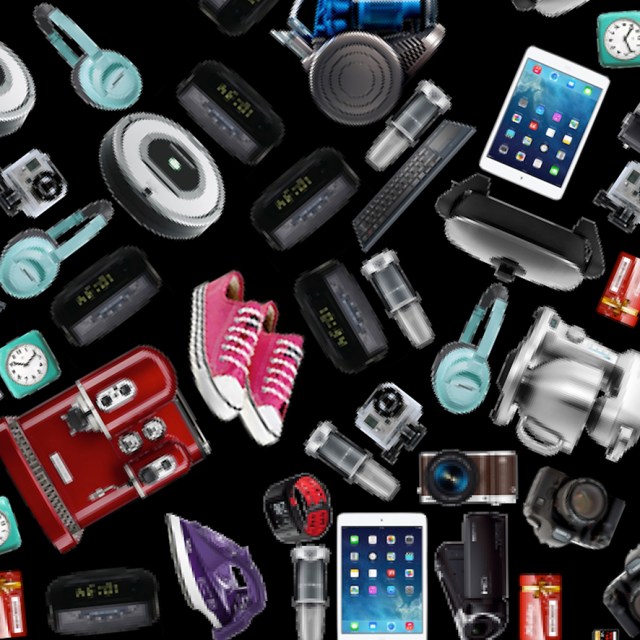
Alrey Batol, ‘Clearance’, 2015. Interactive video game, 16:9 colour stereo. 46 x 55cm. Courtesy of the artist.
Danielle: Yeah, Batol’s work really resonated with me! Another of my favourites was Dana Lawrie’s large-scale painting, Rainbow (2015). Lawrie is a Brisbane-based artist who holds a Bachelor of Fine Arts, Honours (First Class) from the Queensland College of Art. Her self-portraiture works explore themes of permanence and impermanence. In Rainbow, Lawire paints fractions of various body parts in positions that are put together to make the shape of a rainbow. Lawrie’s use of delicate hues of pink and grey make for a work of striking raw beauty that really captures your attention and pulls you in.

Dana Lawrie, ‘Rainbow’, 2015. Oil on unstretched canvas. 210 x 200cm. Courtesy of the artist.
Kerry: The stand out for me was Tai Snaith’s Portrait of a Sunday Painter (2015), a mixed media work exploring the life and work of a fictional female artist named ‘Giogia de Vivre’. I enjoyed the concepts in this work, which not only explore how female artists have been forgotten by history, but also looks at the role of ‘the document’ in the creation of constructed realities. Snaith cheekily creates a body of work and an history for this fictional artist, but at no point gives away ‘the secret’ that the artist in question may not be real. Snaith’s artist statement says she is ‘a visual artist interested in the point where still life becomes real life’.
Danielle: Overall, ‘the churchie’ 2015 offers a wide array of talented emerging artists that represents the diversity and high quality of Australian contemporary art. all of whom are likely to see more and more of in time. I look forward to seeing the next group of emerging artists in next year’s prize, which will be held at the QUT Art Museum.
To check out all of the finalised from the 2015 prize click here. To find out how to enter for the 2016 Churchie Emerging Art Prize click here.
Finally, congratulations to all the participating artists and highly commended winners, Tai Snaith and Sha Sarwari.
Danielle & Kerry
Feature image: Sha Sarwari, ‘National Icon’, 2014. Photographic print. 87.5 x 72.5cm. Courtesy of the artist.
 Engage Arts
You must be logged in to post a comment.